
What is average handle time (AHT)?

Product Marketing Lead, Onboarding & Ecosystem

In a busy contact centre, every second is a data point. Average handle time is the duration of a customer interaction from the first "hello" to the final step of after-call work (ACW).
As one of the most vital call centre metrics, AHT is a delicate balancing act. If it’s too high, costs soar and wait times climb. if it’s too low, customers feel rushed and unheard. This guide breaks down the industry-standard formulas, current benchmarks, and how to find the "Goldilocks" zone where efficiency meets empathy.
Table of contents:
How to calculate average handle time
Average handle times by channel
What’s considered a "good" average handle time?
Average handle time benchmarks by industry
Why average handle time is a high-stakes metric
Average handle time calculation: An example
The limitations of the average handle time formula
Why you should reduce average handle times
How to improve your average handle time (the smart way)
Balance average handle time and efficiency with Dialpad
Average handle time FAQs
How to calculate average handle time
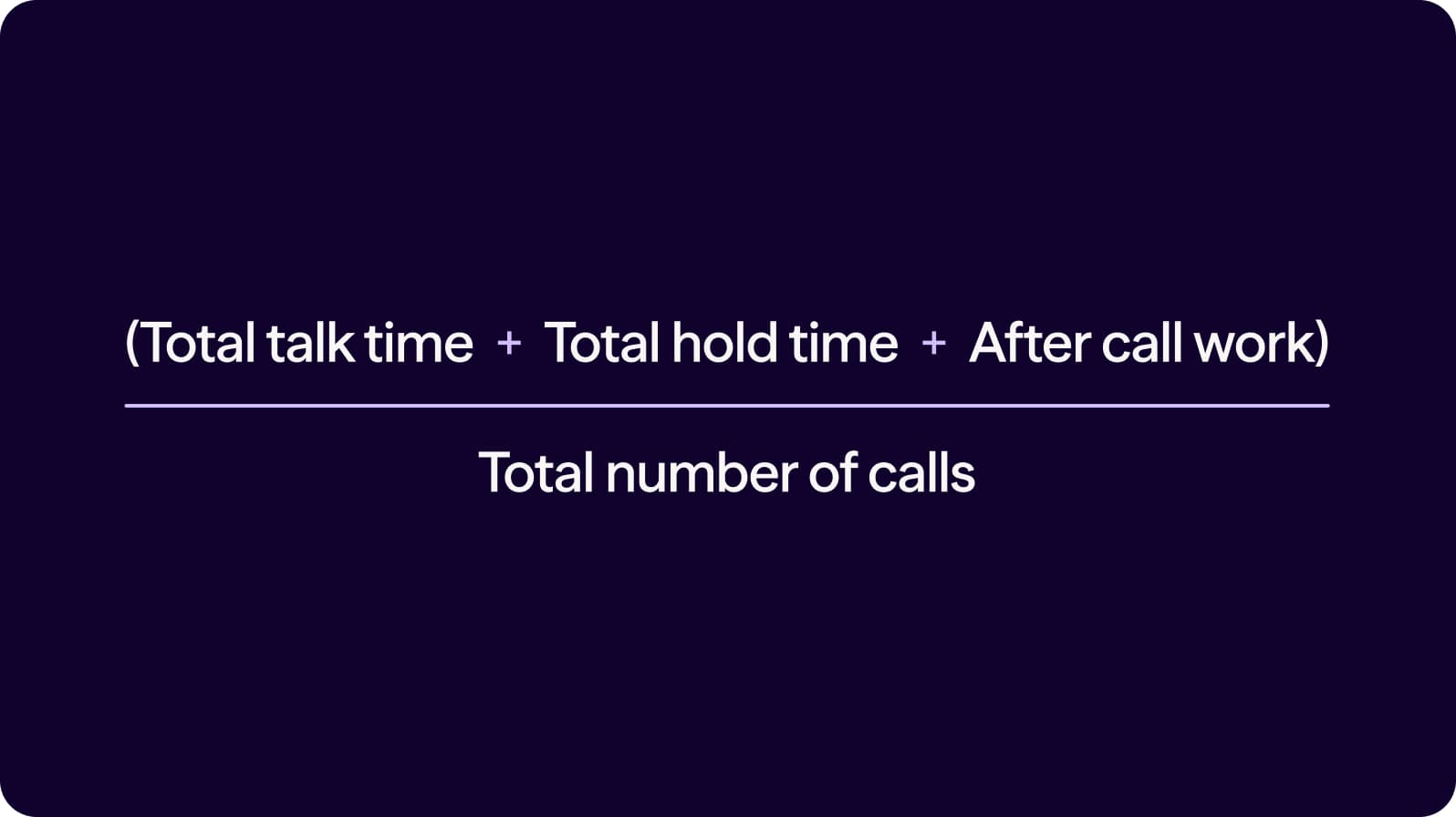
To calculate AHT, you need to look beyond the conversation. AHT tracks the full lifespan of an engagement, including talk time, hold time, and the administrative "follow-up" time agents spend updating CRM fields or sending recap emails.
The formula
Add up your total talk time, hold time, and follow-up time, then divide by the total number of calls handled:
Average handle times by channel
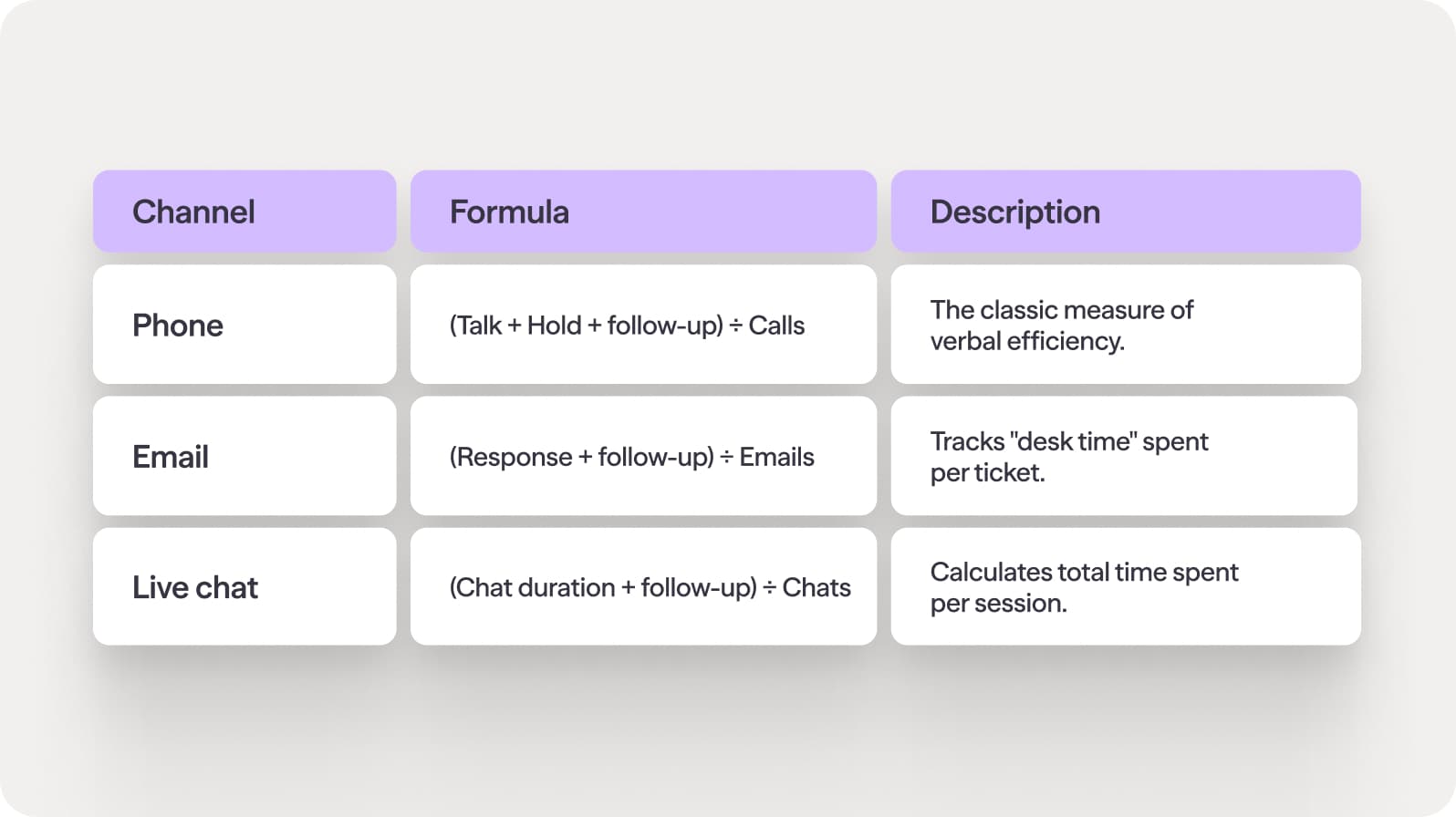
While the math is consistent, the variables change depending on how your customers reach out:
What’s considered a good average handle time?
There’s no single number for AHT. A "good" score depends entirely on your industry and the complexity of the problems you're solving. While six minutes is often used as a broad benchmark, a technical support call will naturally take longer than a simple retail return.
Average handle time benchmarks by industry
Best practice: Don’t just chase the lowest number. High-performing teams focus on first call resolution (FCR) alongside AHT to ensure they aren't just ending calls quickly—they’re actually solving them.
Why average handle time is a high-stakes metric
AHT ripples through every part of your business, acting as a key indicator of:
The customer experience: If AHT is bloated, your queue grows, leading to frustrated customers and higher abandonment rates.
Agent productivity: Spikes in AHT can signal that your agents need better training or that your internal software is slowing them down.
The bottom line: Time is money. Shaving just 15 seconds off your AHT across thousands of calls can save a contact centre tens of thousands of dollars in operating costs.
👉 Related: How to optimise call centre agent productivity
Average handle time calculation: An example
Imagine your team handled 10 calls today. They spent:
50 minutes talking
5 minutes on hold
5 minutes on notes/admin
The math: (50 + 5+ 5) ÷ 10 = 6
The limitations of the average handle time formula
AHT is a powerful tool, but it's a blunt instrument if used in a vacuum.
Quality over speed: A lightning-fast AHT is a failure if the customer has to call back three times.
Complexity bias: Your best agents often handle the hardest cases, which naturally inflates their AHT.
Burnout risk: Pressuring agents to "hurry up" is a fast track to low morale and high turnover.
Why you should reduce average handle times
Reducing average handle times can lead to meaningful improvements across your contact center.
Faster resolutions improve customer satisfaction.
Agents can handle more interactions without rushing.
Better forecasting and staffing efficiencies reduce costs.
Streamlined processes eliminate unnecessary steps
How to improve your average handle time (the smart way)
Improving AHT isn't about telling agents to talk faster. It's about removing the hurdles in their way.
Leverage AI for efficiency: Use call centre automation to handle summaries and note-taking so agents can focus on the human on the other end.
Kill the "Alt-Tab" fatigue: Integrate your CRM (like Salesforce or Zendesk) so agents aren't hunting for info across five different tabs.
Real-time coaching: Use tools that suggest answers to agents while they’re still on the call, cutting down on "dead air."
Build a knowledge base: Maintain a searchable internal wiki so the right answer is always just two clicks away.
Balance average handle time and efficiency with Dialpad
Reducing your average handle time shouldn't feel like a race against the clock. It should feel like a streamlined workflow.
With Dialpad Support, you aren't just timing your agents—you’re empowering them. From AI-powered transcripts that handle your after-call work for you, to live coaching that helps agents resolve issues faster, we help you hit your benchmarks without losing the human touch.
👉 Lower your AHT without rushing your customers
See how real-time coaching and automated summaries help your agents work smarter, not faster.